
Every tower crew knows the morning ritual. You pull up to a site after a cool, humid night, open the outdoor cabinet that houses the baseband units and the rectifiers, and there it is: water beaded on the inside of the door, a white film on a connector, or the dull gray of corrosion starting on a busbar.
The cabinet has an IP rating, the door seals are intact, and it never rains on the inside. Nobody can say where the water came from, so everybody wipes it down and the site goes back on the air, until the next cool night, and the next truck roll.
Telecom cabinet condensation is one of the most common causes of premature failure in outdoor base station gear, and it’s also one of the most preventable. It doesn’t announce itself with an alarm.
It shows up as a marginal RF connector, a rectifier that dies two years early, or an intermittent fault that only happens on certain mornings. If you’re responsible for keeping cell sites up, this is the failure mode worth understanding.
Why telecom cabinets collect water on the inside
The physics is the same as every outdoor enclosure, but telecom cabinets have a few habits that make them especially good at it.
An outdoor telecom cabinet is a sealed metal box, and like all sealed boxes, it breathes. During the day, the radios, rectifiers, and batteries inside generate heat, the air expands, and the cabinet pushes air out past the gaskets and cable entries. At night, the equipment cools down and the air contracts, so the cabinet pulls outside air back in.
On a humid night, that air carries moisture. When the internal surfaces, the cabinet walls, the busbars, the module housings, cool below the dew point, water condenses on them.
By early morning, you have droplets of water inside a cabinet full of live telecom gear, and by the time a technician arrives, most of it has evaporated, leaving only the corrosion behind.
Several things make it worse. Sites that sit at low traffic overnight, or that have been decommissioned but still house backup gear, don’t generate enough heat to keep themselves dry. Coastal sites add salt to the moisture, which accelerates corrosion dramatically.
Sites in climates with big day-night swings, or that see spring and fall freeze-thaw cycles, condense the hardest. And cabinets mounted at ground level, where they sit in tall grass or near standing water, pull in the most humid air of all.
What the moisture actually damages
The damage in a telecom cabinet is concentrated in the places that are hardest to fix in the field.
- RF connectors and jumpers: Moisture works its way into connector interfaces and corrodes them. Corrosion on an RF connector adds return loss and eats signal quality, which shows up as degraded performance long before it shows up as a hard failure. By the time a tech replaces the jumper, the connector body on the radio is often corroded too.
- Rectifiers and power supplies: These run hot and pull air through themselves for cooling, which makes them both a heat source and a moisture magnet. Condensation on a rectifier’s control board or output terminals leads to corrosion, intermittent faults, and premature failure. A rectifier that dies at 3 a.m. can take a whole site down if there’s no redundancy.
- Battery compartments: In cabinets with battery backup, condensation near terminals and intercell connections causes corrosion that raises resistance and shortens battery life. On a site that depends on that backup during an outage, a corroded connection is the difference between riding through the outage and losing the site.
- Ground and bonding bars: Corrosion on the ground bar is easy to miss and hard to forgive, because a bad ground connection shows up as noise, erratic behavior, and protection that doesn’t work the way it should.
The cost shows up as truck rolls, premature module replacements, and degraded site performance, which is to say, the exact things network operators are trying to eliminate.
What actually works
The fix list for telecom cabinet condensation is short, and it’s all cabinet-level hardware that runs unattended.
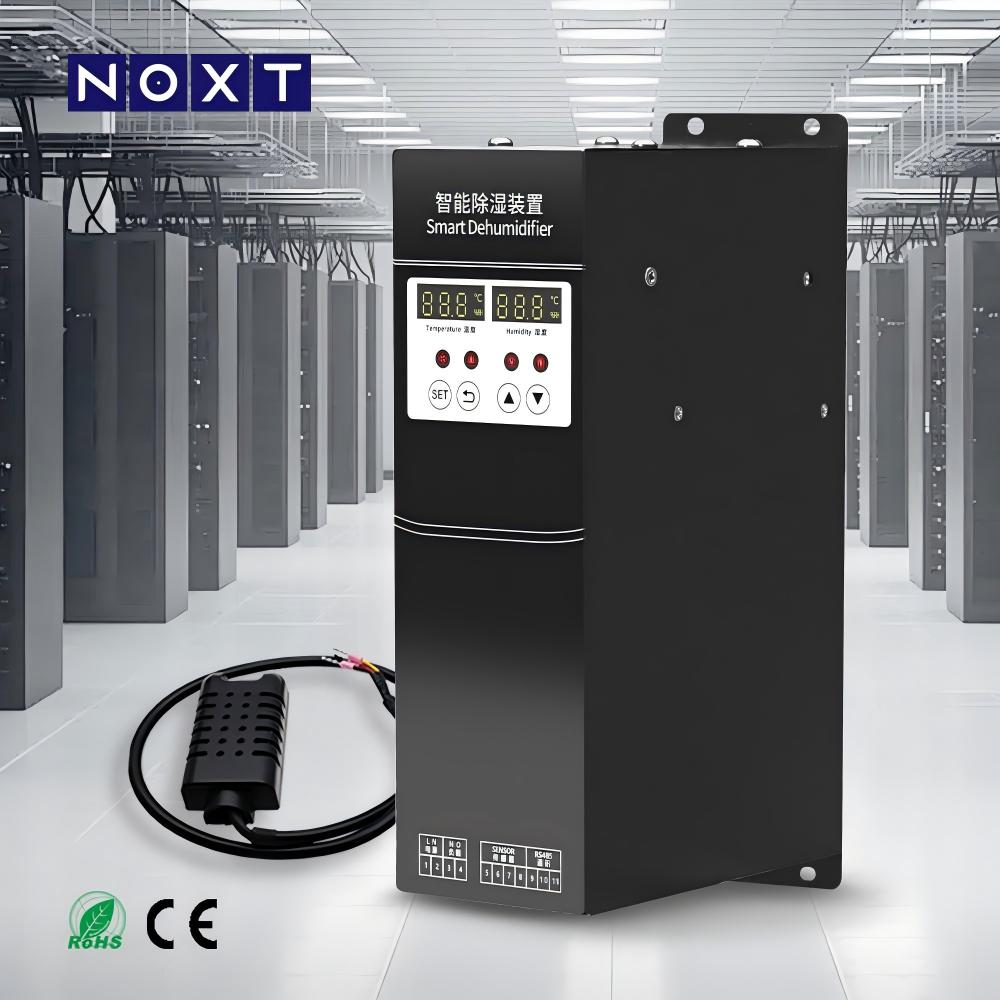
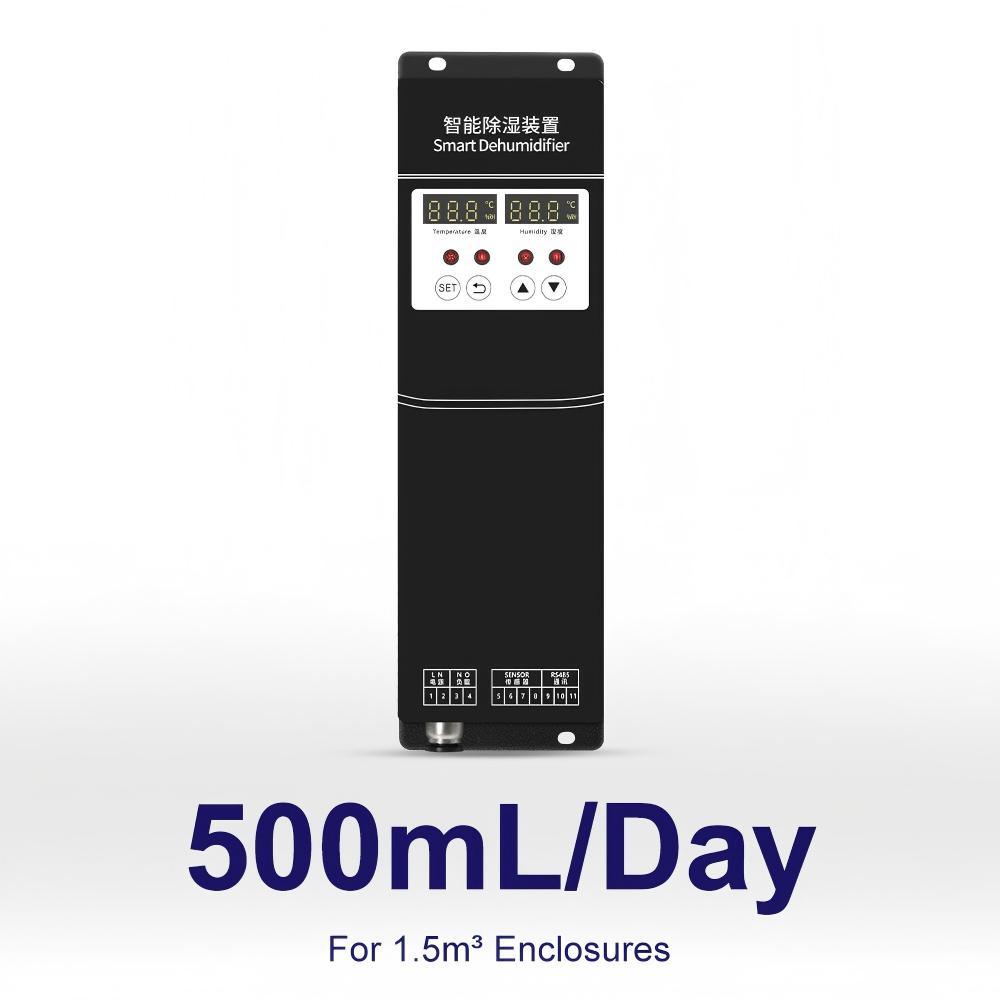
- Remove the moisture with a cabinet dehumidifier: For humid sites, the workhorse fix is a compact thermoelectric dehumidifier mounted inside the cabinet. It condenses water out of the air on a cold element and drains or evaporates it, holding the cabinet at a set humidity level instead of just warming the air. These units run around the clock, need no refills, and only cycle when the humidity climbs past the set point. Because telecom sites are often DC-powered, look for units that run on the site’s nominal DC voltage, typically 24 or 48 V DC, or on standard 120 V AC where that’s what the cabinet has. Matching the supply voltage is the single most common spec mistake, and it’s the easiest one to avoid.
- Add controlled heat for cold sites: In climates where cabinets also freeze, a dehumidifier isn’t a substitute for heat. A low-wattage enclosure heater, switched by a thermostat or a humidity controller, keeps the cabinet above the dew point in winter and keeps battery compartments from freezing. Spec heat and dehumidification together and each one runs less, because the dehumidifier handles the humid months and the heater handles the cold ones.
- Let the cabinet breathe, deliberately: A sealed cabinet breathes anyway, through pressure changes, so the choice isn’t sealed versus vented, it’s uncontrolled breathing versus controlled. A small breather vent with a moisture barrier lets the cabinet equalize pressure without pulling in liquid water. It’s not a cure for a genuinely humid site, but it takes the edge off the daily pumping that pulls humid air in.
- Seal the openings that shouldn’t be there: Check the cable glands and conduit entries, especially at the bottom of the cabinet where water and humid air find their way in. Unused knockouts and worn gaskets are leaks you can fix in ten minutes. And make sure the cabinet isn’t sitting in a spot where it’s constantly bathed in humid ground air, tall grass, sprinklers, or standing water all make the job harder.
What to look for when you buy
If you’re outfitting sites, the spec sheet matters as much as the price. Check the supply voltage first, as noted, then look at the humidity set point, which should be adjustable in the 40 to 60 percent RH range for telecom gear.
Look at how the unit handles the water it collects: hose-drain or evaporative designs beat a collection tray that somebody has to empty on a tower visit. Confirm the mounting works for the cabinet, DIN-rail is the standard, and check the manufacturer’s documentation for the environment.
Many quality units are built to CE and RoHS, which suits a lot of industrial telecom work, but if your program requires listed equipment, confirm the paperwork before you standardize on a model, not after you’ve installed fifty of them.

Around-the-clock moisture removal keeps radios, rectifiers, and connectors from corroding.
Build it into the site survey
The sites that keep failing are the ones nobody surveyed for moisture. When you’re planning a deployment or a retrofit, add a humidity check to the site survey: what’s the climate, how humid is the worst season, is the site coastal, does the cabinet sit in shade, and what voltage does the cabinet have available?
That ten-minute survey tells you which sites need a dehumidifier, which need a heater, and which need both. Standardizing on one climate-control package per site class is how operators turn this from a recurring repair cost into a one-time capital cost.
A maintenance note for tower crews
The checks don’t need to be elaborate. On a normal site visit, look for beading on a cool morning, check that the dehumidifier is actually cycling, and confirm the drain is clear and the sensor is clean.
A unit that’s dead is invisible until the cabinet corrodes, so a thirty-second glance at the humidity display is worth more than a diagnostic report.
And when you replace a corroded connector or a failed rectifier, ask whether the cabinet has a moisture problem, because the part you just swapped is going to corrode again until somebody fixes the environment it lives in.
The short version
Telecom cabinet condensation is a small, quiet problem with a big cost, and it has a standard engineering answer.
Give the cabinet controlled ventilation, add a humidity-controlled dehumidifier on the sites that need it, add controlled heat where winters demand it, and check the hardware on the same schedule as everything else at the site.
On gear that’s supposed to run for years between visits, a compact DIN-rail dehumidifier that sips from the site’s DC bus is cheap insurance, and it’s the difference between a cabinet that corrodes and a cabinet that just works.