
Walk through any plant and you’ll see the same thing: cabinet heaters humming away in July, burning power in enclosures that haven’t been cold in months.
Someone mounted a heater years ago, wired it straight to power, and nobody ever questioned it. The heater runs because it runs, and the panel gets cooked for no reason.
The fix is a controller, but not everyone agrees on which kind, and the terminology doesn’t help. Thermostat, hygrostat, thermo-hygrostat, humidistat, temperature and humidity controller, they all get thrown around like they’re the same thing.
They’re not, and picking the wrong one means either wasted energy or condensation you thought you’d solved. Here’s the plain-English breakdown.
The three jobs, and the three devices
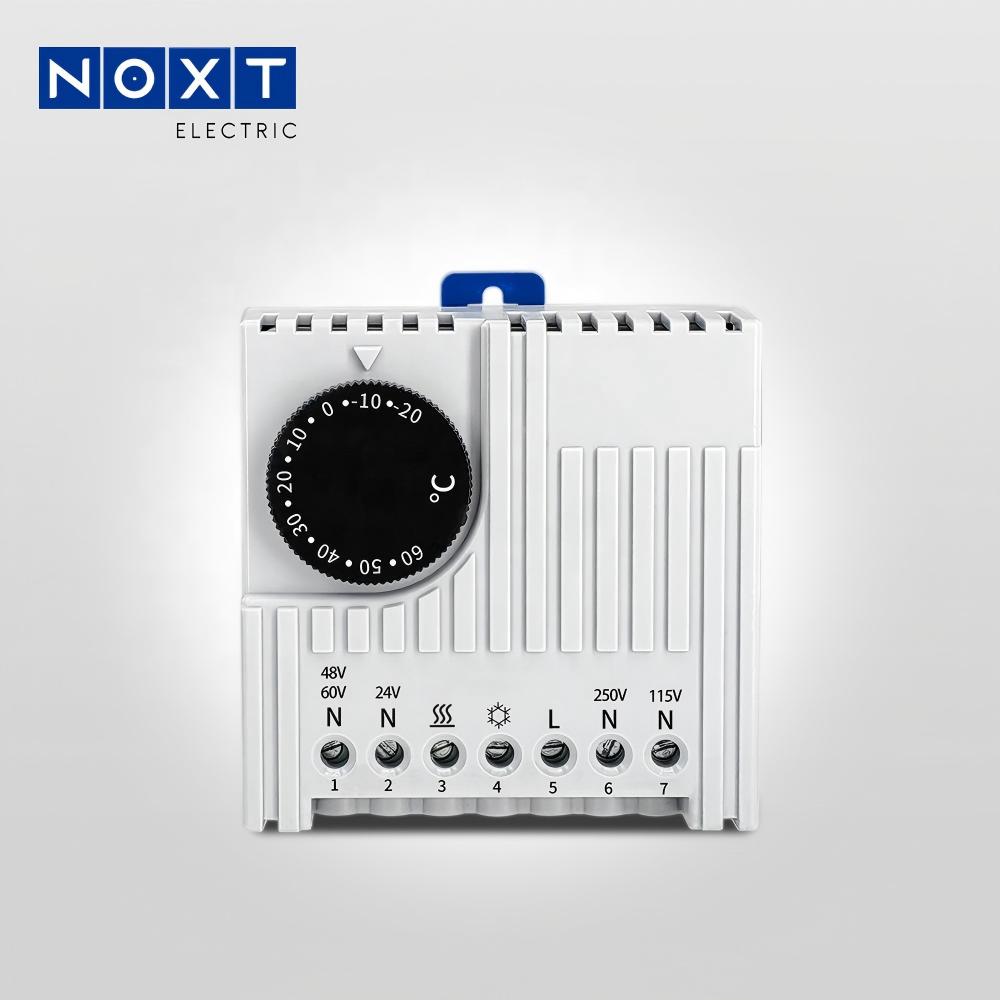
- Thermostat: responds to temperature. An enclosure thermostat is a switch that opens or closes based on the air temperature in the cabinet. Set it to switch on at 40 °F and it closes the circuit to the heater whenever the cabinet dips below that. It’s simple, mechanical or electronic, and it’s the right tool when your only problem is cold. If the enclosure sits in an unheated spot at a remote site in Minnesota, a thermostat-controlled heater is the classic, reliable answer.
- Hygrostat: responds to humidity. A hygrostat, also called a humidistat, senses relative humidity instead of temperature. Set it to switch on at 70 percent relative humidity and it fires the heater whenever the air inside gets muggy, regardless of whether it’s 30 degrees or 80 degrees outside. This is the one that catches the condensation problems a thermostat misses, because condensation is a humidity event, not just a cold-weather event. A coastal cabinet can sweat in June when it’s 75 degrees out, and a temperature-only thermostat will never notice.
- Thermo-hygrostat: responds to both. A thermo-hygrostat, or a temperature and humidity controller, combines the two. It heats when the cabinet gets too cold, or when the humidity gets too high, whichever comes first, and it leaves the heater alone when conditions are fine. This is the modern default for anything that’s serious about protection without wasting power, and it’s why most DIN-rail controllers sold for enclosures today do both jobs in one box.
Why running a heater 24/7 is the expensive way to do this
It’s worth doing the math once, because it changes how you look at controllers. A modest 100-watt heater running nonstop burns about 876 kilowatt-hours a year, which at typical U.S. industrial rates is somewhere north of $100 a year for a single cabinet, before you count the air conditioning that then has to remove that heat in summer. Multiply by fifty cabinets and you’re lighting money on fire.
Controlled properly, that same heater might run a few hundred hours a year, mostly on cold nights and muggy spring mornings. The controller pays for itself in the first season. And there’s a second, quieter benefit: components last longer when they’re not being thermally cycled.
Heat is the enemy of electrolytic capacitors, seals, and lubricants. A heater that idles all summer in a sealed box is slowly aging everything it’s supposed to protect.
Which one for which cabinet?
Here’s a practical way to think about it.
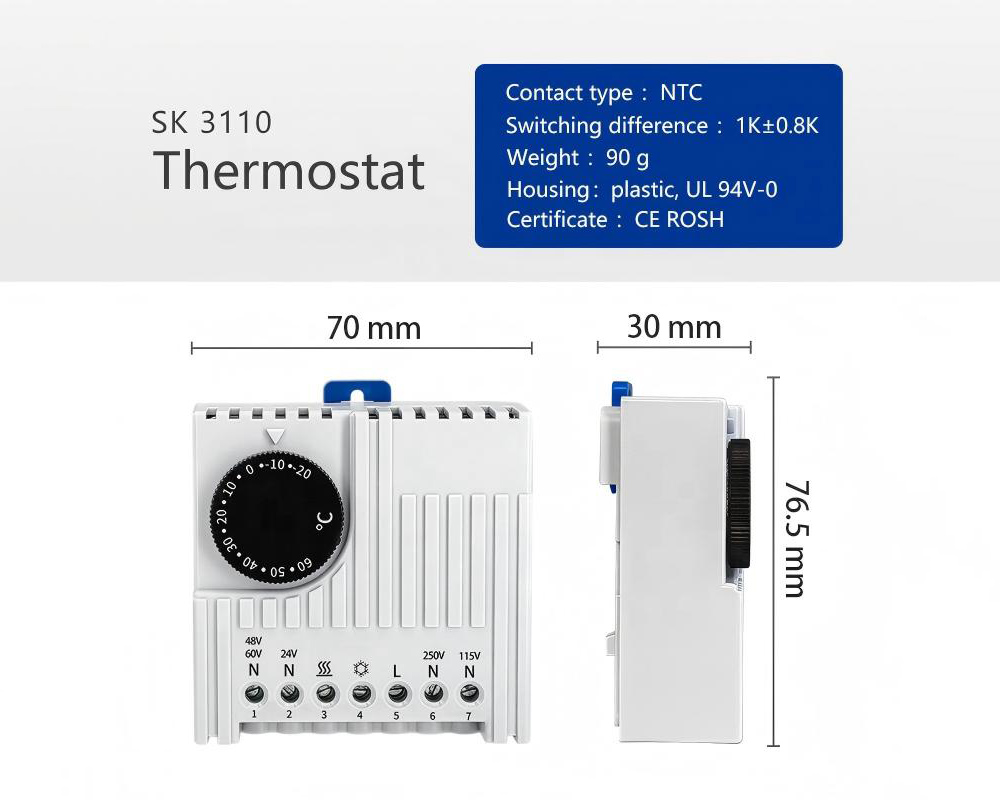
If the cabinet is indoors, in a conditioned space, and condensation is only a winter concern, a basic thermostat is honestly fine. It’s cheap, it’s mechanical, and there’s not much to go wrong.
If the cabinet is outdoors, in an unheated building, near a washdown area, or anywhere humidity spikes with the seasons, skip the plain thermostat and go straight to a temperature and humidity controller.
The extra money buys you protection on the days that fool everyone: the warm, humid stretch in spring when the cabinet interior is cooler than the outside air and water starts forming on every metal surface. A thermostat sitting at its 40-degree set point just watches it happen.
For sealed outdoor enclosures, coastal sites, and cabinets full of electronics, the thermo-hygrostat is the right call, and many of the newest units add a dehumidifier or fan output so one small DIN-rail device can manage the whole cabinet climate.
How to set it up so it actually works
A controller is only as good as its settings, and this is where most installations go sideways. A few practical rules:
Set the temperature a few degrees above the dew point, not to “comfortable.” You’re not trying to keep the cabinet at 70 °F. You’re trying to keep the coldest internal surface above the dew point. A set point in the mid-40s to low-50s °F is usually plenty for a heater in an outdoor cabinet. Higher just wastes power.
Set the humidity around 60 to 70 percent. Corrosion risk climbs quickly above about 60 percent relative humidity, so a humidity set point in the 60 to 70 percent range gives you a buffer without cycling the heater constantly. If the cabinet houses really sensitive electronics and the site allows it, you can run lower, but every percentage point you drop means more heater runtime.
Use the differential. Controllers have a small dead band, or differential, so the heater doesn’t click on and off every thirty seconds. A differential of a few degrees, or a few percent humidity, keeps the cycle times reasonable and saves the relay. If your controller lets you set it, don’t leave it at zero.
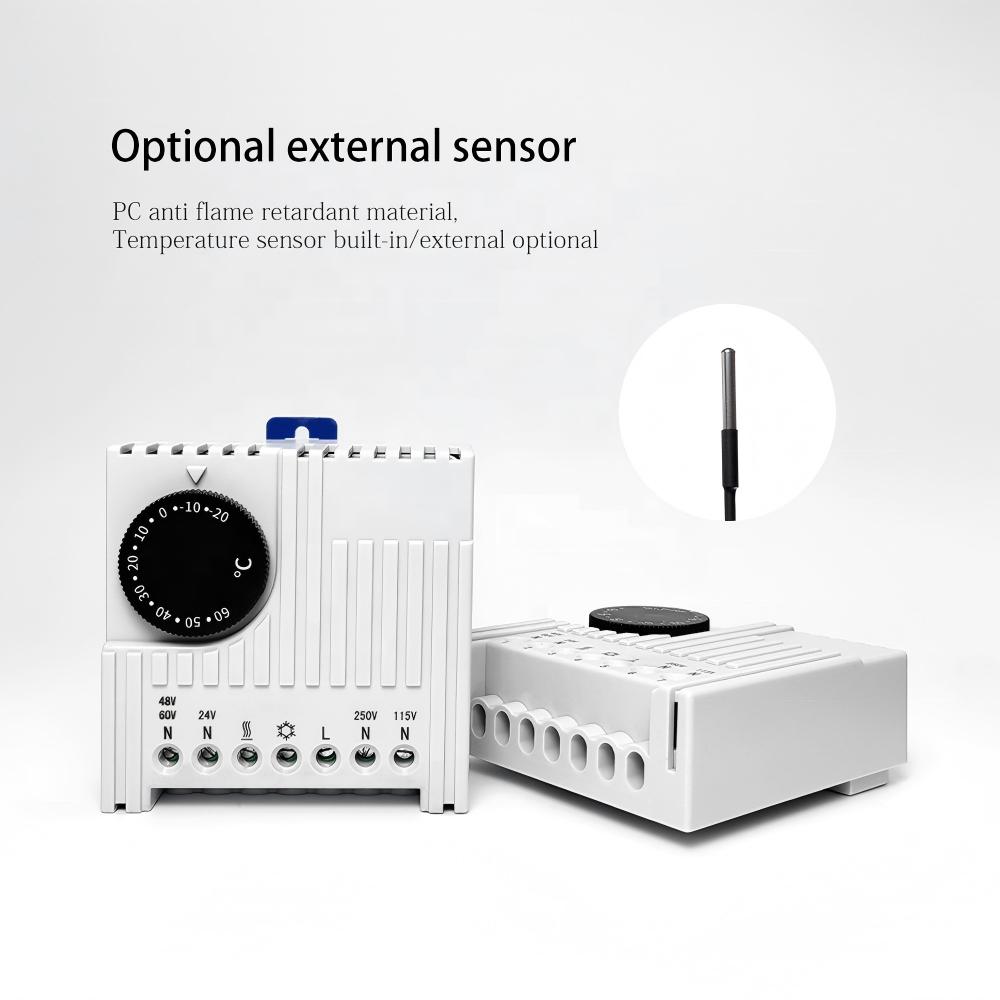
Mount the sensor where the problem is. The controller’s sensor should be reading the air near the bottom of the cabinet or near the components most at risk, not right next to the heater’s discharge. A sensor sitting in the heater’s warm airflow will tell the controller everything is fine while the far side of the cabinet is condensing. If the controller has a remote sensor option, use it.
Keep the cabinet’s own airflow in mind. Heaters and controllers need the air in the cabinet to move a little. If the box is packed so tight that nothing circulates, you’ll get cold pockets and hot spots no matter how smart the controller is. A little breathing room, or a low-speed fan in big cabinets, makes the controller’s job much easier.
What to buy
For new builds, the cleanest answer is usually a DIN-rail temperature and humidity controller rated for the supply voltage in the panel, paired with a heater that matches the cabinet size.
Many manufacturers, including the enclosure-climate specialists in Yueqing like Zhenrui Electric, sell the controller and heater as a matched set with the sensor and the relay already figured out.
If you’re sourcing direct, just confirm the input voltage (120 V or 240 V for U.S. panels), the relay rating, and that the documentation satisfies your project’s listing requirements.
A temperature and humidity controller is one of those upgrades that feels like a luxury until you install it, and then you wonder why every cabinet doesn’t have one. The heater stops being a dumb appliance and becomes part of the protection system, running only when the cabinet actually needs it.
Your components stay cooler in summer, drier in spring, and warmer in winter, and your power bill stops subsidizing a heater that never learned to take a day off.