
Ask anyone who commissions medium-voltage switchgear in the spring and they can describe the scene: you open a feeder compartment after a cool, humid night and there’s water beaded on the backplate, a chalky tracking mark creeping along an insulator, or a dull haze of corrosion on a busbar joint. The cabinet is sealed. It never leaked.
And yet, year after year, condensation in switchgear is one of the most common reasons utilities find tracking damage, corroded contacts, and relay operations nobody can explain.
Condensation in a switchgear cubicle is a different problem from a little moisture in an ordinary control box. The voltages are higher, the insulation margins are tighter, and the failure mode isn’t a nuisance trip, it’s a flashover.
Here’s why it happens inside switchgear and what the industry is doing about it, which is increasingly a smart dehumidifier designed for the cabinet, not just a heater.
What condensation actually does to switchgear
Start with the reason switchgear tolerates high voltage at all: clean, dry insulation. Air is a fine insulator until moisture and contamination get involved. When condensation forms on an insulator or a bushing surface, it leaves a damp film.
Dust and salts in that film create a conductive path, and leakage current starts creeping across the surface. The current dries the path in streaks, which is where the fine chalky tracking marks come from, and each discharge etches the surface a little more.
Left unchecked, tracking erodes the insulation until the creepage path shortens enough to flash over. That’s a fault that takes a feeder out, stresses protection, and can damage the breaker that clears it.

The lower-voltage side has its own version of the damage. Condensation on busbar joints and bolted connections starts corrosion, corrosion adds resistance, and resistance turns into heat under load. Contact surfaces that were silver-plated and tight develop hot spots.
Relay and breaker compartments collect the same moisture, and corrosion inside a mechanism or on a control board makes gear behave erratically right when you need it to behave predictably.
None of this happens overnight. It’s a slow process that builds over seasons, which is exactly why it’s dangerous: the cabinet looks fine in a daytime walkthrough, because the condensation burned off hours ago.
Why switchgear cabinets condense
Switchgear cubicles are sealed metal boxes, and like every sealed enclosure, they breathe. Air expands out through gaskets and cable entries as the cabinet warms during the day, then contracts at night and pulls humid air back in. The temperature swing does the rest: when internal surfaces cool below the dew point, water condenses on them.
Several things make switchgear especially prone to this. A lot of it lives where the humidity is worst to begin with: outdoor ring main units, pad-mounted gear, underground vaults, and unheated substation buildings. Loaded feeders generate heat and keep themselves dry, but lightly loaded or seasonal feeders cool right down at night, which is when condensation forms.
Spring and fall are the classic seasons, because warm days and cool nights swing the temperature through the dew point twice a day. Coastal sites add salt to the moisture, which makes the tracking and corrosion damage worse and faster.
The traditional fixes, and where they fall short
Every utility has its own version of the old answers, and they all have the same limitation: they manage the symptom without removing the moisture.
Better sealing. Tighter gaskets help keep rain and dust out, but they don’t stop the cabinet from breathing, and a more airtight box actually traps the moisture that’s already inside.
Space heaters. A heater raises the internal temperature above the dew point, so water can’t form, and it’s still the right tool for cold climates. But the water vapor stays in the air, and in a confined MV compartment a heater that runs hard can stress insulation and waste energy. Heaters also do nothing once the power is off, which is exactly when condensation forms on an idle feeder.
Ventilation. Cutting vents or leaving a door cracked pulls in more humid air and more dust, which is the last thing a switchgear compartment needs.
Desiccant bags. They absorb moisture until they saturate, then quietly stop, and somebody has to remember to check them. In a compartment you’re supposed to open once a year, that’s not a plan.
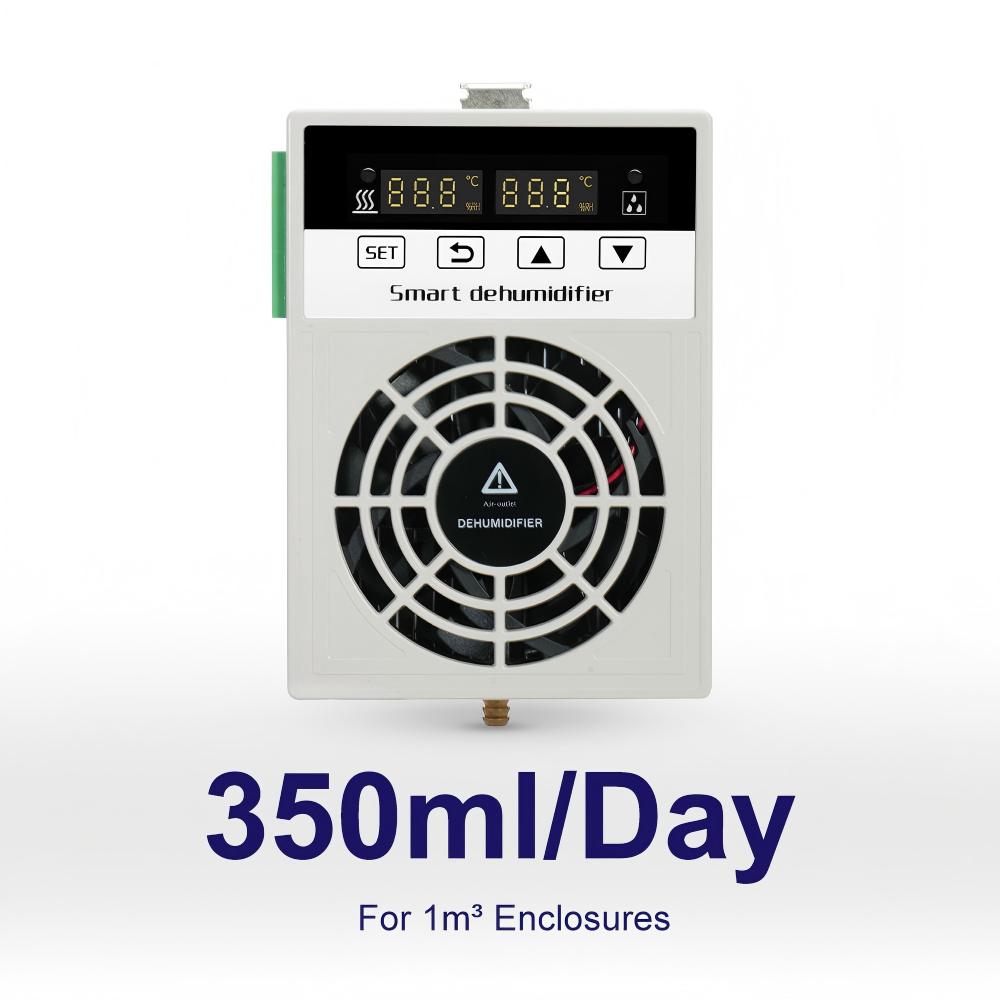
The shift in the industry has been toward actively removing the moisture. A thermoelectric, or Peltier, dehumidifier mounted inside the cubicle condenses water out of the air on a cold element and drains or evaporates it, holding the compartment at a set humidity instead of just warming the air above the dew point.
It works around the clock, needs no refills, and runs only when the humidity actually climbs. That’s why switchgear dehumidifiers have become standard spec on outdoor and coastal projects rather than an afterthought.
What to look for when you spec one
If you’re adding dehumidification to switchgear, whether you’re a utility retrofitting existing cubicles or an OEM designing it into new gear, a few details decide whether it works or becomes another maintenance item.
Supply voltage. Match the unit to the compartment. Most U.S. sites run 120 V AC; many imported and industrial cabinets run 220 to 240 V AC, and DC-fed sites need a unit that runs on the site’s DC bus. Confirm the voltage range before you order, because the wrong voltage means either no dehumidification or a burned-out unit.
Set point and control. The whole point of a smart unit is that it doesn’t run constantly. Look for an adjustable humidity set point, typically 45 to 60 percent relative humidity, and a sensor that reads the compartment air rather than the air right beside the unit. Below about 60 percent RH, corrosion and tracking slow to a crawl, so you don’t need to chase bone-dry conditions.
Drainage and maintenance. Units either collect water in a small tank, drain through a hose, or evaporate the condensate. For switchgear, hose-drain or evaporative designs beat a tank you have to empty, because nobody wants to open a live MV compartment to empty a tray. Check that the drain path can’t drip onto insulation or live parts.
Mounting and clearance. DIN-rail mounting is the standard, and the unit needs to sit where it doesn’t block airflow, crowd other components, or reduce creepage distances in the compartment. Manufacturers publish mounting clearances; respect them, especially in medium-voltage sections.
Certification and documentation. For utility and inspected work, ask for the actual test reports and listings up front. A lot of capable dehumidifiers are built overseas to CE and RoHS, which is fine for many industrial jobs, but U.S. utility specs often require recognized listings, so confirm before you commit.

Cold-climate pairing. In regions where cabinets also freeze, a dehumidifier isn’t a substitute for heat. The clean solution is both: a thermostatically controlled heater to keep the compartment above freezing and above the dew point in winter, and a dehumidifier to hold the humidity down the rest of the year. Spec them together and each one runs less.
Where to put it
Condensation isn’t uniform inside a switchgear assembly. The cable compartment at the bottom is usually the wettest, because it’s closest to the vault or the ground and sees the most outside air; the busbar compartment up top runs hotter and stays drier.
If you’re retrofitting one unit, start in the cable or breaker compartment where the moisture lives, and add units per section on the worst sites rather than trying to dry a whole lineup with one small dehumidifier.
A maintenance note
Once the hardware is in, the discipline is checking it on the right schedule. Read the humidity display on a cool morning, not at noon, confirm the drain is clear, and keep the sensor clean. Log the readings through a season so you can see whether the unit is actually holding the compartment where you set it.
And when you find tracking marks or corrosion, treat them as evidence of an ongoing moisture problem, not a one-time event, because the condensation that caused them will be back next spring.
The short version
Condensation in switchgear is a physics problem with a known answer. Seal the obvious openings, keep the compartment above the dew point with controlled heat where winters demand it, and remove the moisture with a thermostatically controlled, humidity-sensing dehumidifier designed for the cubicle.
Do that and the tracking stays off the insulators, the joints stay cool, and the relay that’s supposed to protect the feeder is still the one that trips, not the one that fails when you need it. On gear that’s expected to run for decades, a small DIN-rail dehumidifier is the cheapest insurance a switchgear lineup will ever have.